
Compute Rental
Ctrl K

Guide

Open Ports

GuideIntegrationsFAQSupport
PricingBlog
Quick StartTop-Up and BillingAccelerating Access to Academic ResourcesQuick StartIntroductionMaintenance and TroubleshootingNetwork
PlatformJetBrain ProjectorTmpWebCal Scholars Program @2026Introduction to the Public Beta/Suqian Zone AAbout UsCopying Data Between InstancesAnalysis of Server Performance MetricsTidal Computing PowerLoad Balancing
Domestic ChipsUsing Huawei MindIEHuawei Ascend NPUMooreThread GPU
Environment SetupCUDA/cuDNNMinicondaPython3.XInstalling DependenciesOverviewImages
Enterprise FeaturesFlexible DeploymentElastic Deployment Release NotesBest Practices for Elastic DeploymentPerformance Metrics Monitoring
Container InstancesJupyterLabRemote SSH ConnectionSave the imageScaling ConfigurationMulti-machine, multi-GPU parallel processingDaemonOverviewChange the billing methodMigration Example (Same Region)Migration ExamplesRemote DesktopReset the system
Choosing a GPUGPU SelectionPerformance Testing
DataUpload DataDownload DataPublic DataPublic Cloud Storage (Highly Recommended)Compression / DecompressionFile StorageLocal data diskOverview
Best PracticesFileZillaGitGromacsHuggingFaceKataGoLinux BasicsMPIOpenCLPyCharm Remote DevelopmentR (RStudio) InstallationSSH TunnelTensorBoardRemote Development with VSCodeVisdomVulkanXShellOpen PortsWeChat MessagesPerformanceExpose multiple servicesMoney-Saving TipsComputation Precision IssuesSoftware Sources

Best Practices

Open Ports

07/30/202691622 views

Note: Opening ports requires enterprise authentication. You can access the authentication portal under “Control Panel” → “Account” → “Account Security.” If you are an individual user, you can use the SSH Tunnel Tool to proxy any port to your local machine for access.

Since instances do not have their own public IP addresses, you cannot open arbitrary ports.However, WebCal maps a publicly accessible address to the 6006和6008 port of each instance—that is, it maps the 6006和6008 port within the instance to the publicly accessible ip:port. The mapping supports both TCP and HTTP protocols; you can choose the protocol yourself. The ip:port can be obtained via the “Custom Services” entry point:
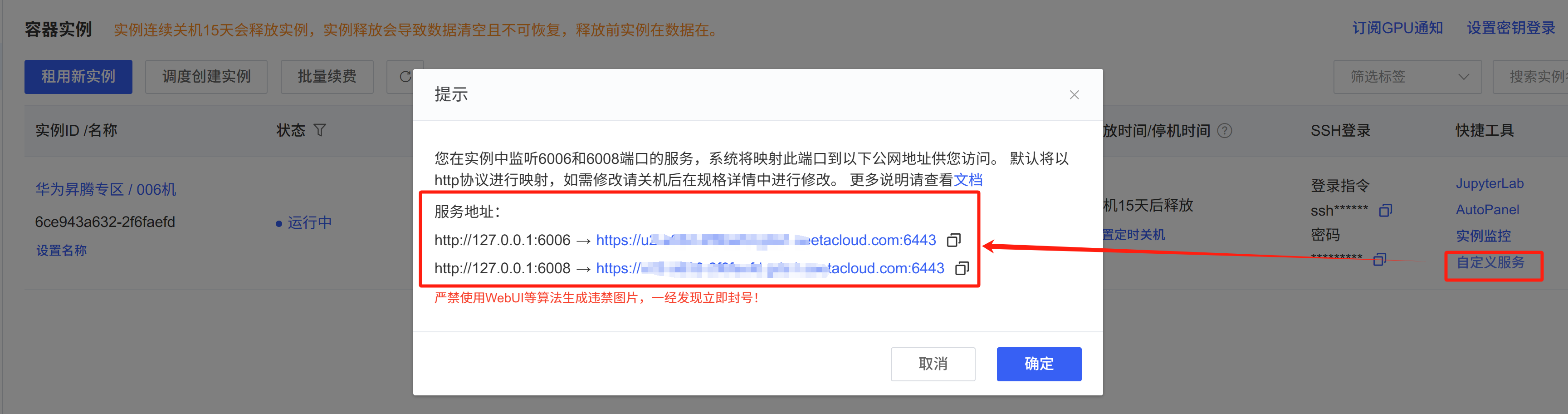
Click "Copy" to retrieve the address, for example: https://u39-b3fb-39a640fd.nmb2.seetacloud.com:8443. u39-b3fb-39a640fd.nmb2.seetacloud.com and 8443 represent the address and port, respectively.

For examples of how to use this feature, see: Visdom

Next articleWeChat Messages
Compute Rental DocsBack to Guide