Jev Is the New AI Sensation, Yet It Does Not Say a Word. How Does It Work?
TL;DR
Former OpenAI researcher Diogo Almeida founded TypeSafe AI and launched Jev, a decision model that does not generate sentences. Its typed choices, scores, and probabilities target low-latency automation, browser agents, context compression, and model routing.

New models keep appearing, each eager to prove it can write and chat. Yet the model currently drawing the most attention across the internet is Jev.
It does not speak.
Diogo Almeida was a researcher at OpenAI. He worked on ChatGPT and later proposed reinforcement learning from human feedback, or RLHF.
That approach helped define the direction of large language models over the past several years. But while it propelled the industry into a boom, Almeida became increasingly skeptical of it.
“We had a one-off successful innovation, but we did not turn it into something genuinely useful.”
It took him a long time to identify the problem: the industry kept optimizing computers to process human language. Over four years, models became extremely good at handling human language, but that was not particularly useful for automation because computers operate in a different “language.”
Two years ago, Almeida left OpenAI and founded TypeSafe AI with Erik Gafni and Sasha Sheng. The company remained in stealth until September 15, when it unveiled two things: a $40 million seed round led by DCVC and its first model, Jev.

Jev is still based on the Transformer architecture, but it is deliberately not a large language model and does not output complete sentences.
Give it a program state and a predefined question, and it returns a typed answer: a choice, a score, or a probability between 0 and 1, together with a confidence score.
TypeSafe calls these outputs “calibrated decisions.” That is also why many people were confused when Jev first entered public view.
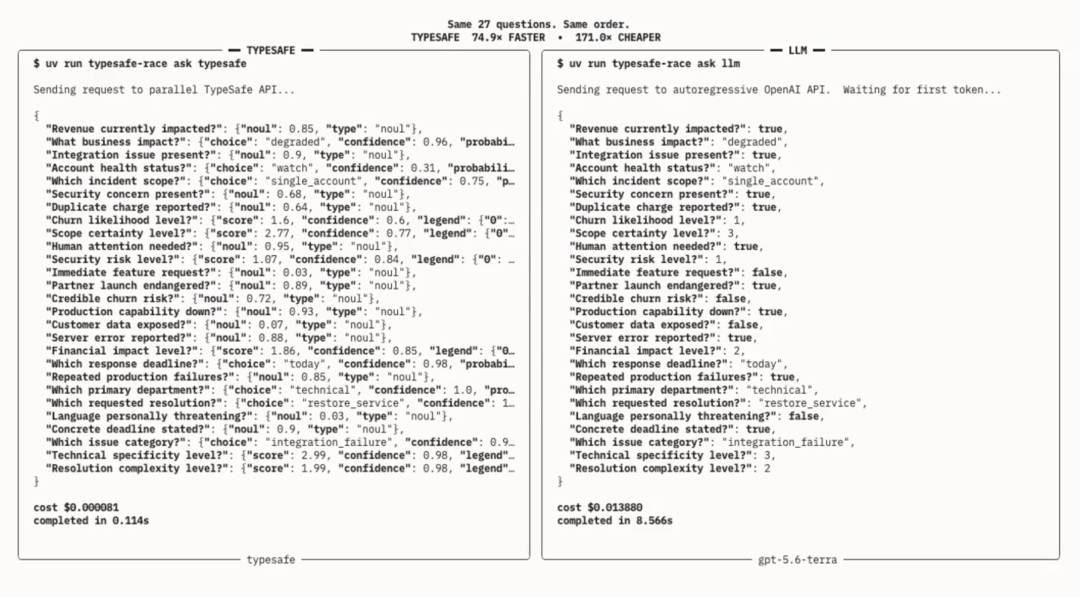
The screenshot compares how Jev and a large language model respond to the same request.
The Hottest Model in AI Takes a Different Path From ChatGPT
To understand what Jev does, it helps to set aside the usual large language model mindset.
Consider a customer-service scenario. A customer writes that the payment service has been unreachable for several days and is hurting their business. The system must decide whether the issue belongs with the technical or billing team, how dissatisfied the customer is, and whether the matter is urgent.
Under TypeSafe's interface design, questions in the same request share one input but are evaluated independently and in parallel. Classification and urgency can therefore be handled together.
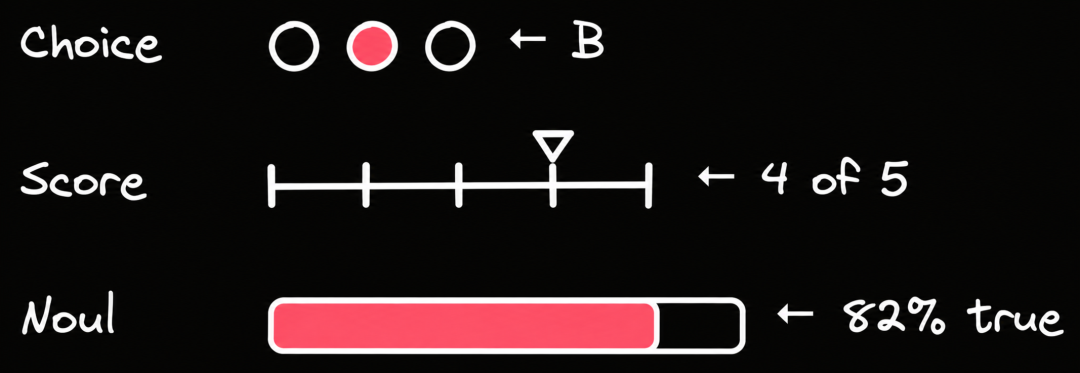
Jev has three basic output forms. Choice selects one item from a list defined by the user and supports up to 255 options, making it suitable for routing and classification. Score places the input on a user-defined scale to measure urgency, quality, or risk. Noul is essentially a yes-or-no judgment whose numerical answer represents the probability that a statement is true.
Every answer includes a full probability distribution and confidence score. The result is strongly typed, so users do not need JSON prompts, extra parsers, or safeguards against a model unexpectedly wrapping the output in a Markdown code block.
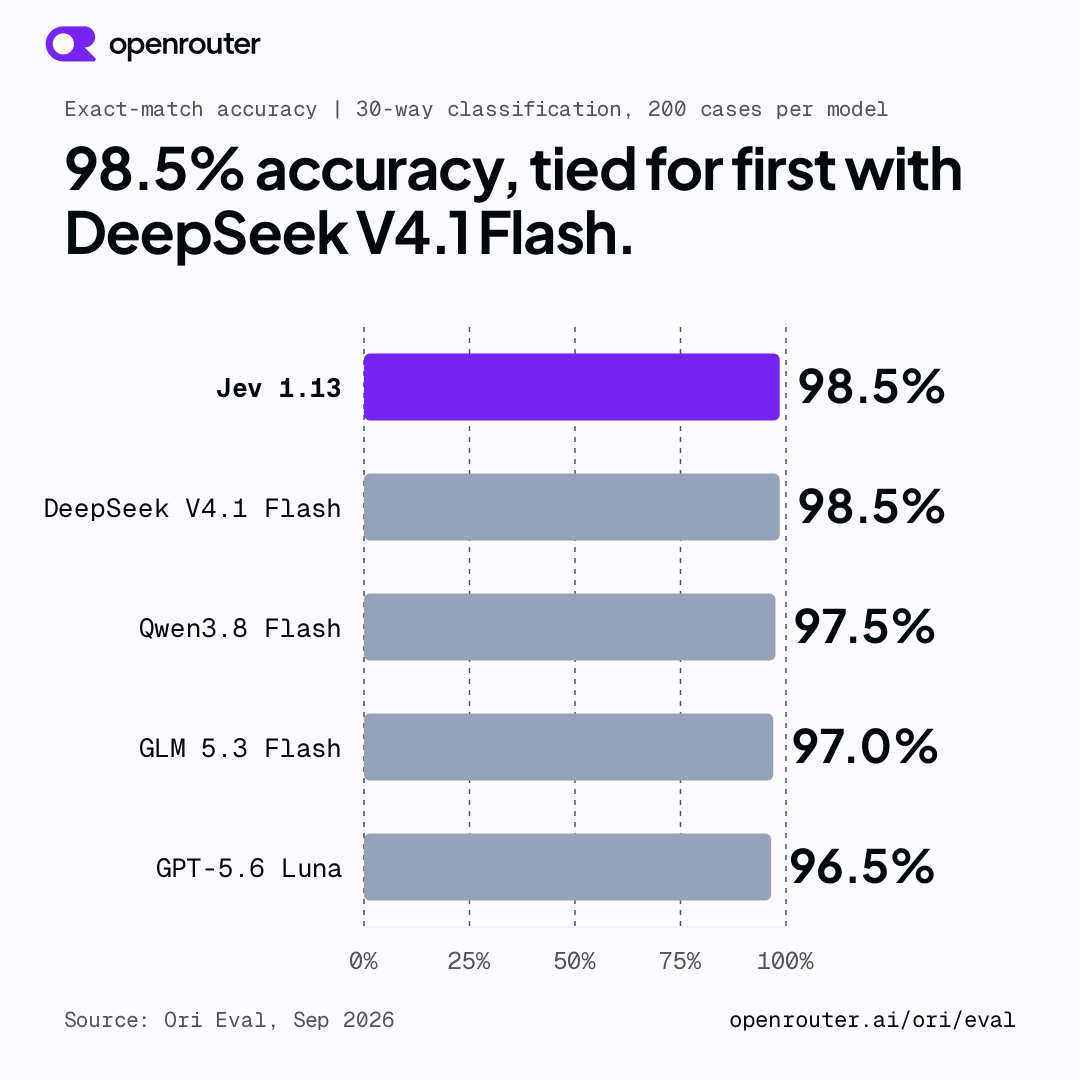
The most immediate benefits are lower latency, lower cost, and fewer formatting errors caused by free-form generation.
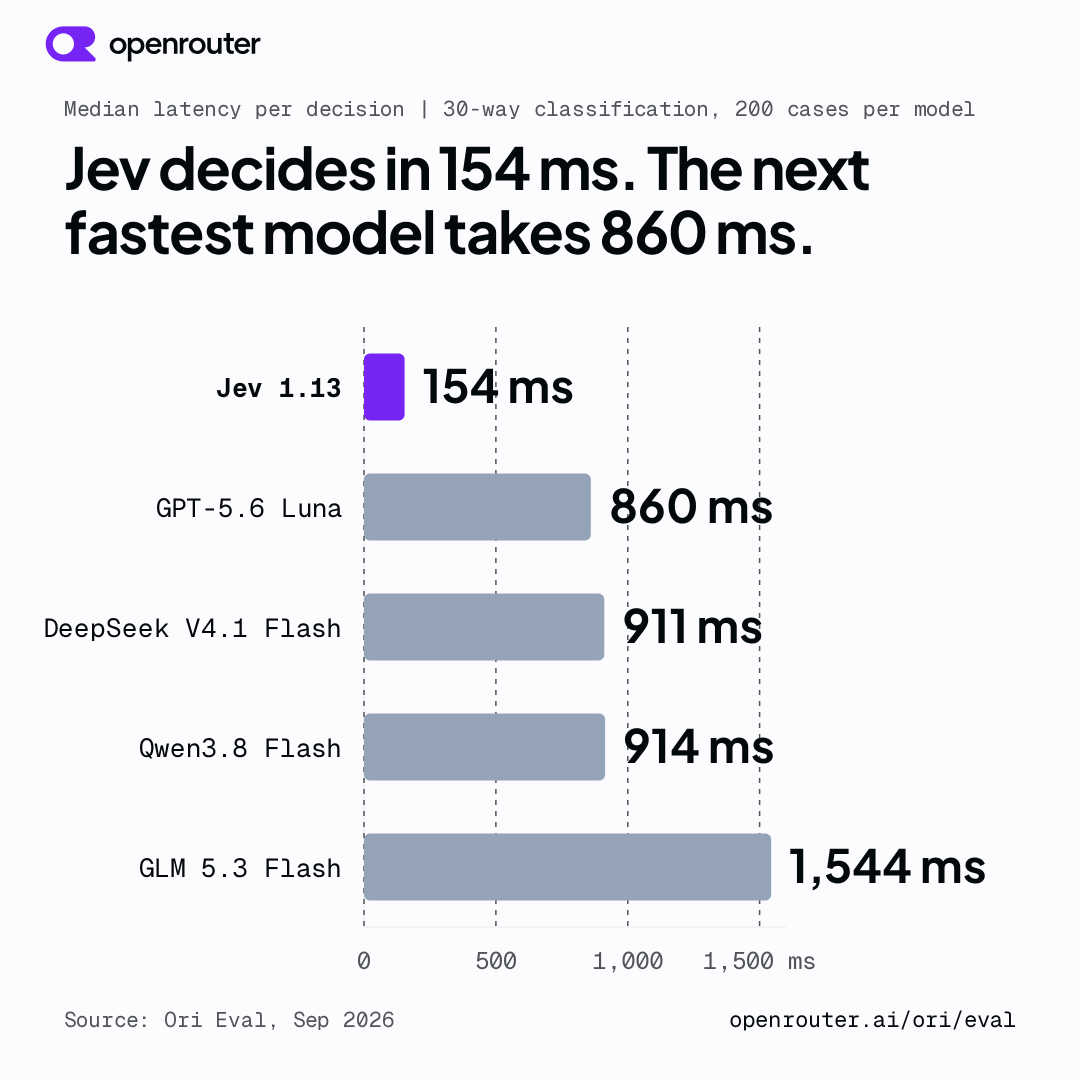
Figures published by TypeSafe put Jev's end-to-end latency between 70 and 500 milliseconds, 20 to 200 times faster than comparable large language models.
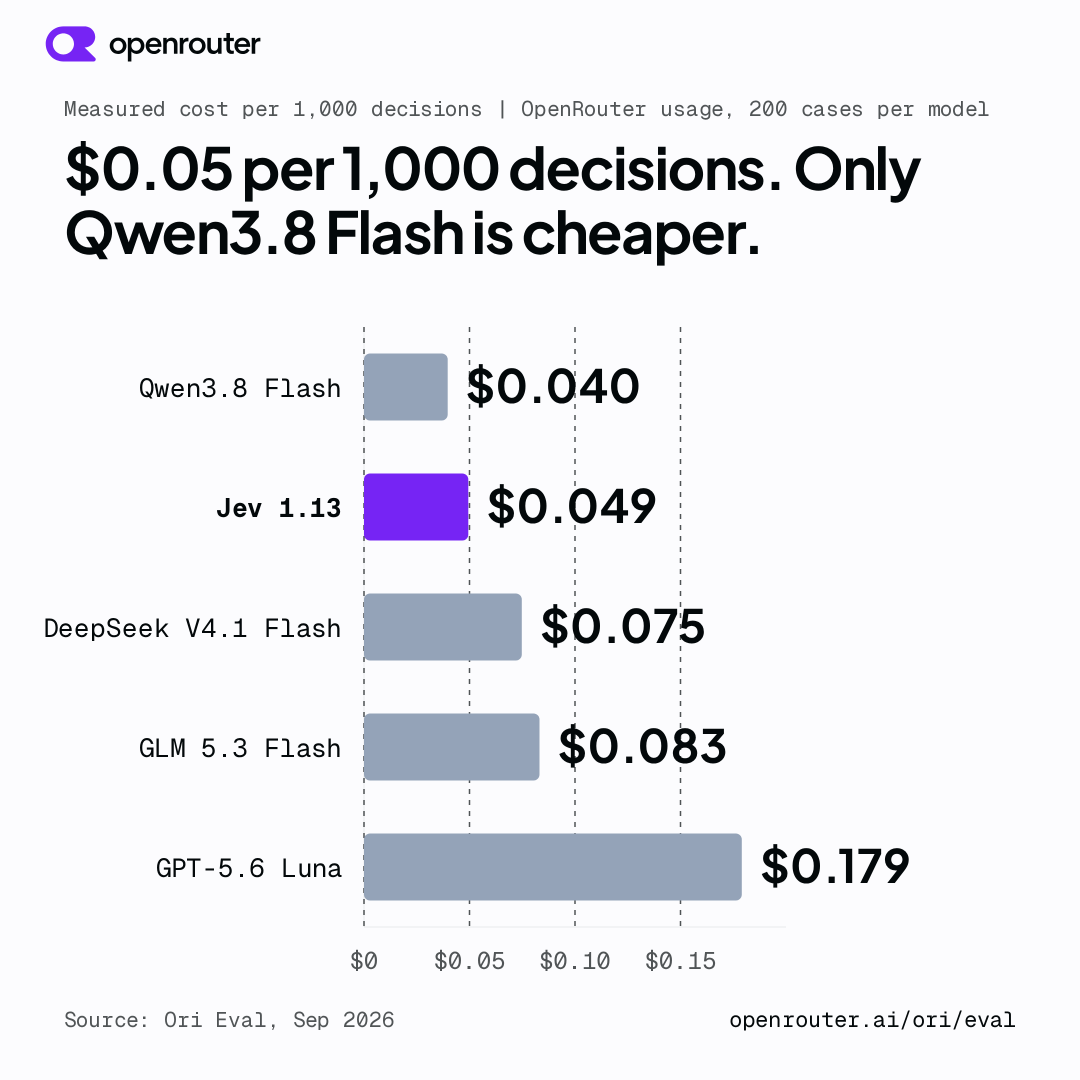
At the current public price, input costs $42 per billion token, or $0.042 per million token. Output is free. Additional questions and option descriptions still consume input token, but there is no separate charge based on the length of a generated answer.
Because users define the possible outputs in advance, the model does not hallucinate outside those choices. “Jev does not hallucinate” means it will not invent an answer beyond the predefined option space; it can still choose the wrong option within that space.
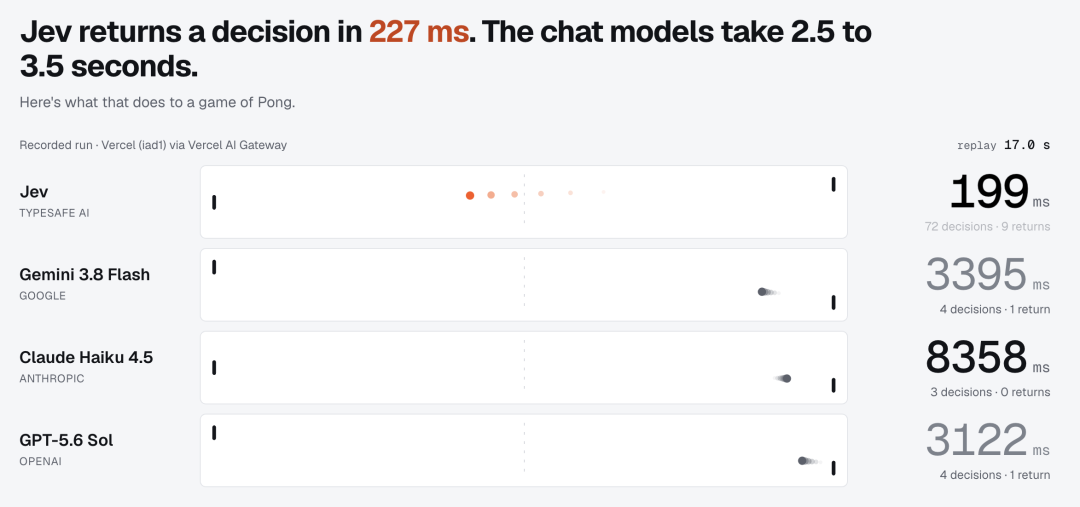
In a public Ably Pong demonstration, Jev made 47 control decisions in 12 seconds, while Gemini, Claude, and GPT made only two or three in the same period, even though the latter models were usually correct.
The program fed Jev the game's numerical state directly: the ball's position and direction, the paddle's position, and the ball's predicted vertical coordinate when it reached the paddle. Jev selected one of three options: move up, move down, or stay still.
Ways to Use Jev
Building a playable product around Jev still requires game logic and real-time communication. In the project above, the backend advances the game and calls the model, while Ably sends the new state to the browser. In other words, Jev does not generate the rules, graphics, or networking. It is inserted only into the repeatedly executed three-choice decision step.
Its speed opens up more use cases. Jev can serve as the decision layer for computer control, helping agents execute instructions quickly. It can also compress context by deciding which information matters, rapidly narrowing a context of millions of token.
Browser Use's public jev-ultrafast project implements a browser agent. On each page, it reads the currently actionable elements and turns them into a numbered list: which item is a button, which is an input, what each is called, and what value it currently contains.
Jev receives this structured state, the user's objective, and the action history. The program dynamically generates Jev's available choices from the elements that actually exist on the current page.
Use Jev as an action-decision layer to operate a computer quickly
For a flight search, the goal might be: “Find a one-way flight from Zurich to London, set the specified date, passenger count, and cabin, and stop when matching results appear.”
In each round, the program asks several questions at once: should it click, type, select from a drop-down, or wait? If it should click, which numbered element? If it should type, which numbered input? These questions share the same page state but are answered separately.
The program then uses only the target that matches the selected action. If the action is click, it uses the click target and temporarily ignores the other answers.
When a city name must be entered, the program separately calls a small text-generation model to produce the value based on the objective and current input field. After the browser performs the action, it reads the new page state.
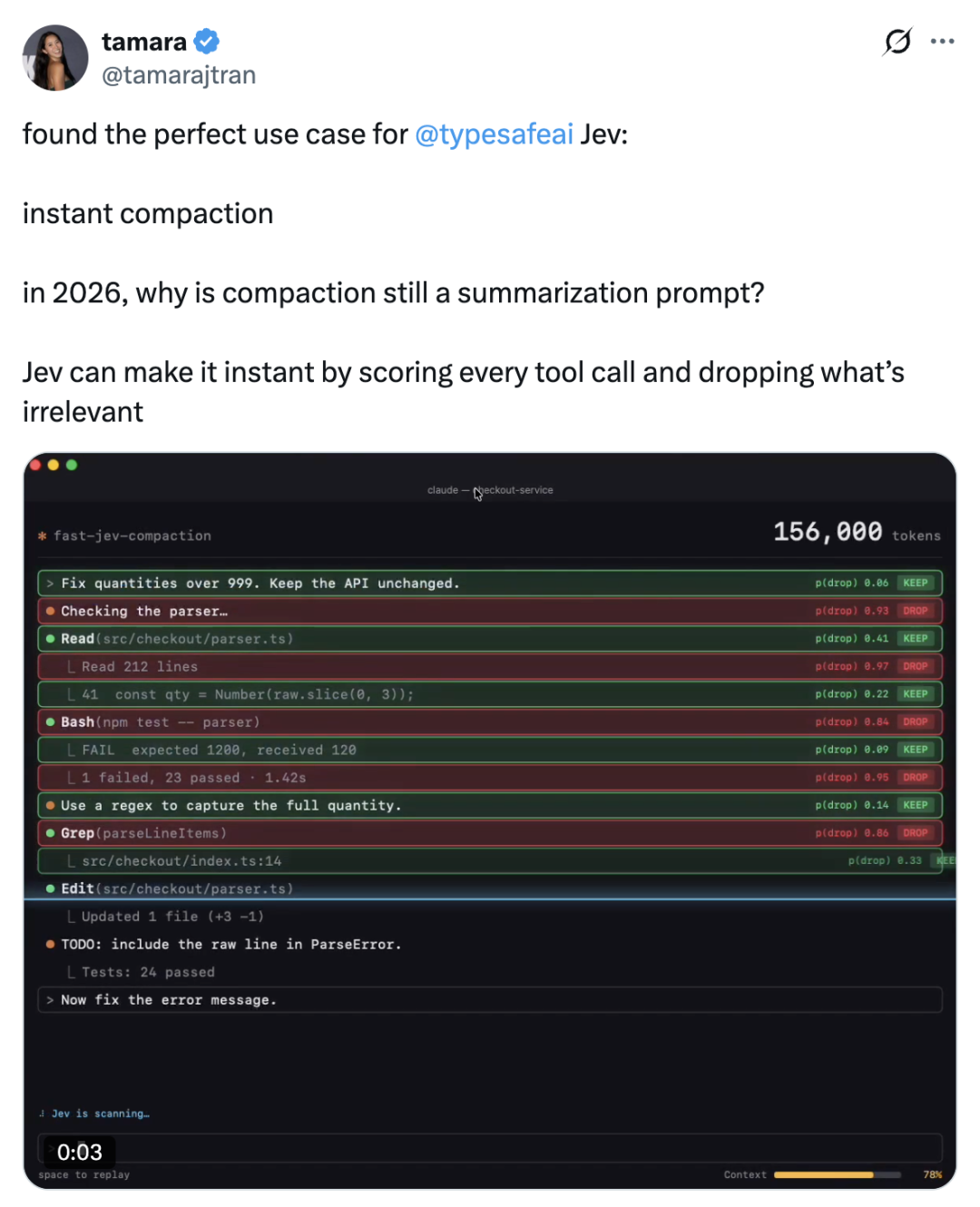
Use Jev to judge information importance and compress context almost instantly
Vercel software engineer Pranit Sharma said his company used OpenAI's ChatGPT Luna 5.6 to run a classifier that checks command safety. When Vercel replaced OpenAI's Luna with Jev, processing became 5 to 18 times faster and accuracy improved substantially.
Nikhil Mudholkar, CTO of Bryo AI, also tested Jev against Gemini for classifying business emails. Gemini was slightly more accurate in his test, but cost 10 to 20 times more.
The same pattern can be built independently. Start with a table in which each row contains an email subject, body, received time, and necessary context.
Then split the workflow into explicit questions. For an email saying, “My order was charged twice and I need this handled today,” Choice can decide whether it belongs in support, sales, partnerships, or another queue; Noul can judge whether the sender explicitly requests action; and Score can assign a priority.
“Ultimately, this approach shifts some responsibility for handling hallucinations to the user,” explained Armin Ronacher, CTO of Earendil. “Users must decide: if the probability is only 50%, perhaps I can ignore it. But if it reaches 95%, then I can use it.”
Ronacher said another potential application is model routing. Predicting whether a task needs a particular model is useful, but using a large language model to make that decision can be expensive. Jev is inexpensive and fast enough to make such routing practical in real time.
Automatically assign the right model according to task complexity
The Smartest Decision
The name Jev comes from the 19th-century economist William Stanley Jevons. Jevons' paradox says that when the cost of a commodity falls, people use more of it. In this case, a lower cost of intelligence should lead to intelligence being used more broadly.
Once calls become cheaper, they can be used in places where they were previously not worth the expense. Almeida clearly likes the comparison. His vision is not a future dominated by a few enormous applications, but one where countless small intelligent judgments run everywhere, “more like the early internet than the large applications people are trying to build today.”
TypeSafe has not disclosed Jev's exact architecture. Outside observers generally speculate that it was adapted from an open-source large language model.
The company calls the category System One Models, borrowing from Daniel Kahneman's concept of intuitive thinking. The name emphasizes intuitive judgment rather than chains of reasoning, with models specially tuned for specific tasks.
TypeSafe recommends breaking a complex judgment into several explicit questions and combining the answers in code instead of asking one model to handle everything at once.
Almeida said he predicted early that he would end up working with synthetic data. It may have been the smartest decision of his life, smarter than taking a company public and even smarter than relying on real human feedback.
TypeSafe is currently the only company pursuing this particular route, but Ronacher expects followers to appear as the model's practical value becomes clearer. TypeSafe also plans to release more versions for different use cases.
Asked whether the company counts as a frontier lab, Almeida replied: “The main product of frontier labs is either fear or hype. I hope our main product is intelligence. We are not the kind of lab obsessed with creating unlimited wealth, building religious narratives, or trying to make a god inside a data center.”
Demand exceeded expectations after Jev launched, and the API briefly stopped responding. One user applied it to filter a niche information feed, reading relevant posts from the previous three days and asking eight questions. The run took about two seconds and cost $0.007, helping remove bait content and hidden advertising.
Another team connected Jev to an entire marketing-analysis workflow. It scanned Meta's ad library, compared the lifespan of different ad formats, and assessed the competitiveness of creative scripts before filming, making judgments that once required manual work 30 times faster and reducing the cost to less than $3.
AI said much less, while software got more done.
We Are Hiring
📮 Resume submission email hr@webcal.ai
✉️ Email subject “Name + Position” (Please include projects, a portfolio, or relevant links with your resume.)


Editorial team
Product Team @ WebCal
The official product team behind WebCal. We build high-performance computing infrastructure and decentralized cloud solutions.